
Matagorda County Court Records After Arrest
After a Matagorda County jail arrest, two record tracks can exist at the same time. The jail track is kept by the Matagorda County Sheriff's Office and the Matagorda County Jail. It deals with booking, custody, jail bond records, holds, and release logistics. The court track starts when a complaint, information, indictment, or related charging paper is filed. That court record is the source to check when the question is what charge is actually pending, whether a charge was amended, and which clerk can issue a copy.
The local prosecutor is the Matagorda County District Attorney. The official page names District Attorney Steven Reis and gives the courthouse office at 1700 7th Street, Room 325, Bay City, TX 77414-5094, phone 979-244-7657, fax 979-245-9409, and email dattorney@co.matagorda.tx.us. Prosecutor review matters because booking charges can change. An officer may book a person on one allegation, but the prosecutor may file a different charge, reduce it, add another count, reject it, or present it to a grand jury.
For custody and booking detail, the natural companion record is the Matagorda County jail inmate records path. Booking photos, when available or requestable, belong with the Matagorda County jail mugshots topic. Court records after a jail arrest are narrower: they follow the filed criminal case, the charge status, the bond orders, and the final court action.
Find Matagorda County Court Records
The official local starting point is the Matagorda County Public Record Search page. It links to civil, family, probate, judicial, and jail records. The Tyler/Odyssey public access portal then shows case records, criminal records, civil/family/probate case records, court calendar, jail records, jail bond records, and incident records. The research environment could load the landing page, but the direct search pages returned a human-verification challenge. Because of that, exact case-search field labels were not captured.
The practical search sequence is short. Start with judicial or criminal case records in the Tyler portal. Search by the defendant name or case number if those controls appear in the browser. Check the court calendar if the issue is an upcoming setting. Use the jail records or jail bond records category when the question is still custody or bond at the jail level. If the Tyler page blocks access, is down, or does not show the case, contact the clerk who holds the case type.
- Open the county Public Record Search page and choose the judicial records path.
- Use the Tyler/Odyssey case records area and select the criminal records category when available.
- Search by full name first, then by cause or case number if known.
- Read the charge list, court, filed date, setting, bond entry, and disposition fields shown for the case.
- Request copies from the District Clerk or County Clerk when the online view does not provide the filed document.
The official re:SearchTX court-record portal is a statewide access channel, but coverage and account access vary by court and county. Texas appellate case search is useful only after a case reaches an appellate court. It is not the first stop for a new Matagorda County court record after arrest.
The Tyler/Odyssey landing page is the best visual source for the available local categories. The screenshot below comes from the official Matagorda Tyler/Odyssey portal.
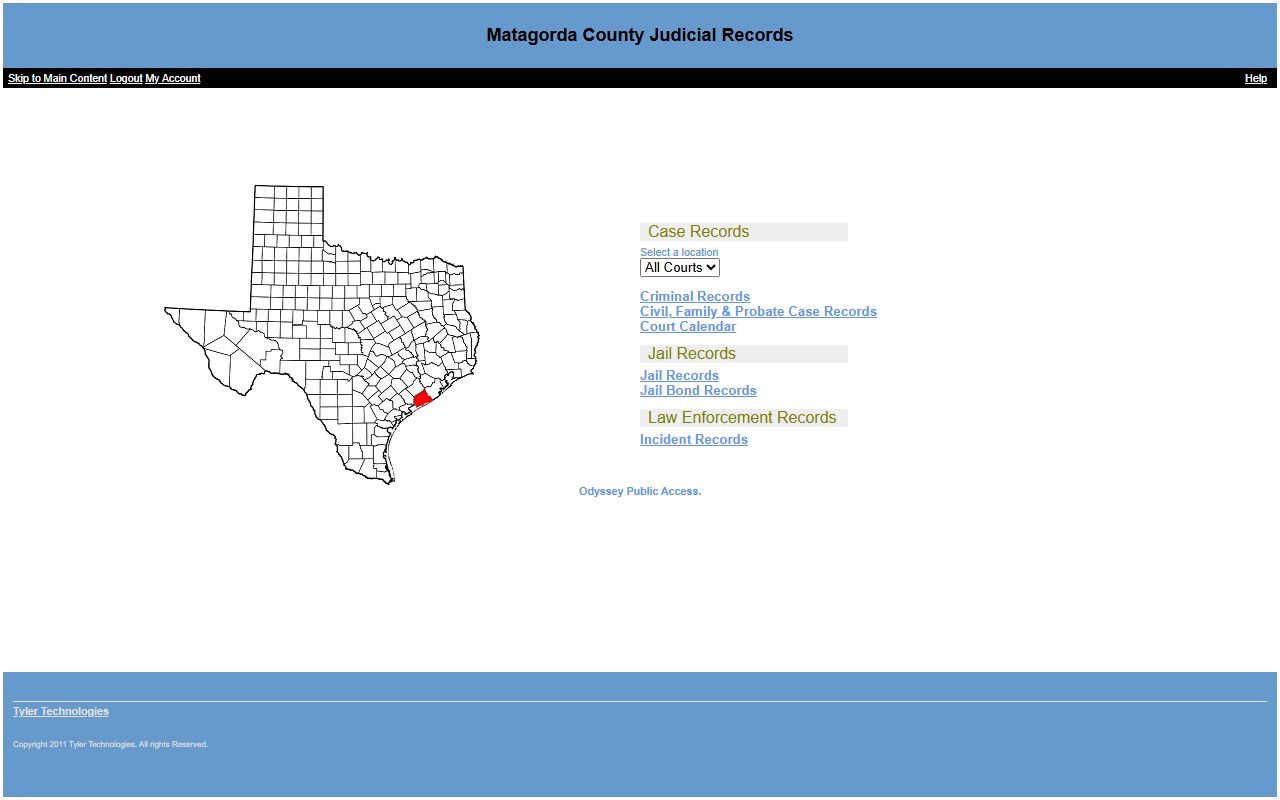
Those categories help separate the court case from jail records, jail bond records, incident records, and court calendar entries.
Matagorda County Clerk Records
Felony and district-court criminal files route through the Matagorda County District Clerk. The official District Clerk page names Janice L. Hawthorne, lists the office at 1700 7th Street, Room 307, Bay City, TX 77414-5092, and gives phone 979-244-7621 and email dclerk@co.matagorda.tx.us. Hours are Monday through Friday, 8:00 a.m. to 5:00 p.m., closed from 12:00 to 1:00 for lunch. The page also identifies criminal clerk staff, including Krisdee Arrington and Jaci Arbing.
County-level criminal records and related clerk services may involve the Matagorda County Clerk. The official County Clerk page names Stephanie Wurtz, lists 1700 7th Street, Room 202, Bay City, TX 77414, and gives phone 979-244-7680, fax 979-244-7688, and email coclerk@co.matagorda.tx.us. The County Clerk page links Odyssey Public Access and a criminal payments channel. This is why a Matagorda County court records after arrest search should not stop with only the jail roster.
| Office | When It Matters | Contact |
|---|---|---|
| District Clerk | District-court criminal records, felony files, and civil/family/criminal record request form | 979-244-7621, dclerk@co.matagorda.tx.us |
| County Clerk | County clerk records, county-level court records, Odyssey access, and criminal payments link | 979-244-7680, coclerk@co.matagorda.tx.us |
| District Attorney | Prosecutor review, filed charges, victim-rights links, and case filing decisions | 979-244-7657, dattorney@co.matagorda.tx.us |
The District Clerk page shows the local contact block and record request resources used for criminal case copies.
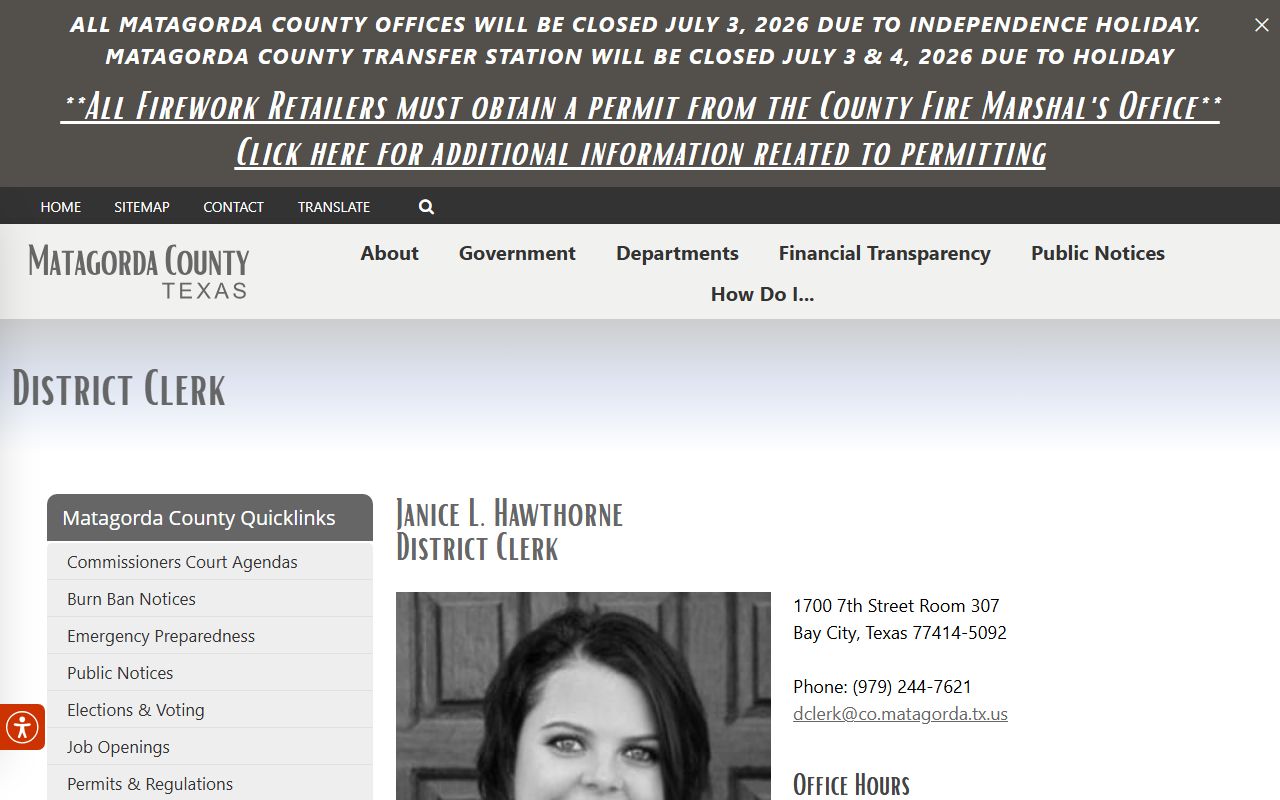
Use the clerk office tied to the court record, not the jail line, when the request is for a filed pleading, certification, or case disposition.
Charging Documents After Arrest
A Matagorda County arrest can appear in jail records before a filed court case appears in the clerk system. The charging document is the bridge between the booking and the court record. It states the formal accusation and gives the clerk something to file, index, and track. The exact document depends on the charge level and case path, but the user goal is the same: find what was filed, not just what appeared at booking.
| Document | Who Uses It | What It Means |
|---|---|---|
| Complaint | Law enforcement or prosecutor | Starts or supports a criminal accusation and may be used early in the case. |
| Information | Prosecutor | A formal charging paper filed by the prosecutor, often used when a grand-jury indictment is not the filing step. |
| Indictment | Grand jury | A formal felony charging paper returned after grand-jury review. |
Texas Code of Criminal Procedure Article 15.17 is the key first-appearance rule after an arrest. Texas Code of Criminal Procedure Chapter 17 governs bail. These statutes do not replace the local clerk record, but they explain why a person may have bond or magistrate activity before the final filed charge is clear in the court record.
Matagorda County Charge Status
Charge status is often the main reason to check court records after a jail arrest. A booking charge can be a starting point. It is not the same as a conviction, and it may not be the final filed charge. Once the District Attorney reviews reports and evidence, the case may move forward as filed, be amended, be reduced, be dismissed, or be refiled. A court record is also where later plea, trial, deferred adjudication, probation, or dismissal entries may appear.
| Status | Plain Meaning | Why It Matters |
|---|---|---|
| Pending | The case or count is still open. | Future settings, bond conditions, and court orders may still change. |
| Amended | The charge wording, level, or count has changed. | The filed charge may differ from the jail booking charge. |
| Reduced | The prosecutor or court action moved the charge to a lower level. | Penalty range, court handling, and final record wording may change. |
| Dismissed | The count or case was ended without a conviction on that charge. | The arrest may still appear unless later expunction or nondisclosure applies. |
| Disposed | The case has a final court action. | The record should be checked for plea, verdict, sentence, deferred adjudication, or dismissal details. |
Note: If a case is not found online, ask the clerk about name spelling, filing delay, court assignment, and sealed or restricted status.
Bond Records After Arrest
Bond is part jail record, part court record. Matagorda County's Tyler/Odyssey portal exposes a jail bond records category, while later bond conditions and changes can appear in the court case. Texas Constitution Article I protects bail rights in general terms, and Texas Code of Criminal Procedure Chapter 17 sets the bail framework. Article 17.15 lists rules for setting bail, including that bail should give reasonable assurance of appearance without being used as an instrument of oppression.
The direct jail bond records route could not be inspected because of human verification, so no local field labels should be assumed. The practical route is to check the Tyler jail bond records path if it loads, call the jail at 979-241-3275 for current release logistics, and then check the court case for later bond orders. A hold, detainer, parole matter, bench warrant, or out-of-county warrant may block release even when one charge has a bond amount.
| Bond Type | How It Works |
|---|---|
| Cash bond | Money is posted with the proper court or jail authority under the bond order. |
| Surety bond | A licensed bail bond company posts the bond under Texas rules and any local requirements. |
| Personal bond or PR bond | Release is based on a promise to appear and follow court conditions rather than a full cash deposit. |
| No bond | No release by bond is authorized at that moment for the charge, warrant, or hold. |
| Hold or detainer | Another agency or court reason may keep the person in custody despite bond on another charge. |
Warrants and Court Records
The Matagorda County Sheriff's Office states that the sheriff serves warrants and civil papers. No official public active-warrant list or sheriff warrant-search page was located in the researched county sources. That absence matters. A public page should not imply that Matagorda County offers a live warrant database when the official pages inspected did not show one.
A warrant can still be the reason behind a jail arrest and a later court record. A bench warrant may come from failure to appear or a court-order violation. An arrest warrant may be tied to a new case. An out-of-county, state, federal, parole, or immigration hold may affect release even when the Matagorda charge has bond. For a warrant tied to a filed case, search Tyler/Odyssey judicial records and contact the relevant clerk. For a person already in custody, call the jail line. For non-confidential records not online, use the county Public Information Act route.
Charges vs Convictions
A charge is an accusation. A conviction is a final legal result after a plea, verdict, or other court action that creates a conviction under law. Court records after a jail arrest may show both at different stages, so the label matters. A pending charge should not be read as proof that the person was convicted. A dismissed case should not be read as a conviction. A deferred or other disposition should be read from the court record itself, not from a roster summary.
| Point of Comparison | Charge | Conviction |
|---|---|---|
| Stage | Accusation filed after arrest or prosecutor review | Final result after plea, verdict, or qualifying court action |
| Proof level | Based on probable cause or formal filing rules | Based on court process and the required criminal burden |
| Where to verify | Clerk record, charging document, docket, and prosecutor filing | Judgment, sentence, disposition entry, or certified clerk copy |
| Effect | May be pending, amended, dismissed, or refiled | May affect sentence, custody, probation, criminal history, and future rights |
Sealed or Expunged Court Records
Texas uses specific legal tools for limiting or removing access to qualifying criminal records. Chapter 55A of the Texas Code of Criminal Procedure covers expunction. Texas Government Code Chapter 411 includes nondisclosure provisions. In plain terms, expunction is closer to removal of the qualifying record, while nondisclosure limits public access to certain criminal-history information. Eligibility depends on the charge, result, timing, prior history, and court order.
| Point of Comparison | Nondisclosure or Sealed | Expunged |
|---|---|---|
| Public visibility | Public access is limited by court order. | Qualifying records are removed or treated as not existing for many purposes. |
| Government access | Certain agencies may still have access under Texas law. | Access is much more limited and depends on the expunction order and law. |
| Typical trigger | Some deferred or qualifying dispositions under nondisclosure rules. | Dismissal, acquittal, no charge, or other qualifying outcomes under Chapter 55A. |
| Best proof | Certified court order of nondisclosure. | Certified expunction order. |
Texas Business & Commerce Code Chapter 109 is relevant when private businesses publish criminal-record information and the person has an expunction or nondisclosure order. Official court and clerk records remain the place to verify whether such an order exists.
Matagorda County Court Record Fees
The District Clerk civil/family/criminal record request form gives the clearest fee schedule located for Matagorda County court-record copies. The form asks for cause number, court number, case style, requested documents, number of copies, certification choice, requester contact details, signature, and date. It also says requesters should allow 24 to 48 hours. Fees can depend on format and certification, so a requester should tell the clerk whether a plain copy, electronic copy, or certified copy is needed.
| Item | Published Amount |
|---|---|
| Paper copies | $1.00 per page |
| Electronic copies | $0.10 per page, $1.00 minimum |
| Paper converted to electronic | $1.00 per page |
| Certification | $5.00 per document |
| Research | $5.00 per search |
Matagorda County's PIA page says PIA requests are not needed to review public court records or records maintained by the clerk. Use the clerk path first for court files. Use the county PIA route for existing county records that are not otherwise available online or through the clerk, such as some law-enforcement records, subject to Texas Public Information Act exceptions.
Restricted Court Records After Arrest
Not every record connected to a jail arrest is fully public. Texas Government Code Chapter 552 is the Public Information Act, but it includes exceptions and confidentiality rules. Section 552.108 is often relevant to law-enforcement and prosecutor records in active matters, while subsection 552.108(c) preserves public access to basic information about an arrested person, arrest, or crime. Juvenile information, sealed cases, expunged records, medical facts, victim details, and active investigative material may be withheld or redacted.
For casual public lookup, the safest practice is to verify the current case status through the clerk or court portal and avoid treating a partial record as complete. For employment, housing, credit, insurance, tenant screening, licensing, or other regulated decisions, use a legally compliant consumer-reporting process. Public lookup tools and court pages do not replace FCRA-compliant screening.
Important: This site is not a consumer reporting agency, and its information may not be used for FCRA-covered decisions.